Thursday, 17 January 2013

Production Pitches


Directors – Joel, Reca
-       Don’t have to keep every single element of Brecht
-       Obsessed with idea of what goodness was
-       Powerful, relevant, moral questions to current society
-       Beautiful set and costume possibilities
-       Perfect cast size
-       Adapted to modern times
-       Is there a solution to this play?
-       Help us understand Brecht better
-       Aim to make people think
-       Ethical sacrifices we make to survive
-       What is goodness and how is it measured?
-       What does morality look like in the real world?
-       Themes: - Plight of morality, naivete, innocence, facades, true love, goodness, self interest, role of women, theoretical morals, idealism vs practicality/reality, man’s inherent isolation, social Darwinism
-       Image concepts – Dark play, shente is the light, rugged china, grungy, willow tree (hanging branches)
-       Street feeling (long extending corridor)
-       Burning of cigars to reveal dirty, nasty inside
-       Target audience: High school students, faculty,

Sound
-       Natural
-       Traditional
-       “Forest road”
-       Chinese bamboo forest
-       Music – unrecognizable,
-       Dark ominous but still with some positive mood and hope
-       Music used to interrupt but also immerse the audience into the play
-       Interlude music (Wang’s interlude)
-       Smooth transitions in music
-       Sound effects – makes it build up (so rain inside and outside)
-       Distancing through sound effects (not making it too realistic)
-        
Set
-       Simple, compelling
-       Caring vs apathy
-       Loss of innocence
-       Conforming to society
-       Lighting from windows
-       Shen te’s shop in the middle of the street
-       Brechtian influence – detailed tobacco shop
-       Cheap, almost gaudy atmosphere
-       Modern, urban feel
-       Falling apart
-       Evening time
-       Not very safe
-       Gaudy but faded colours
-       Grimy
-       Shady, dark feeling
-       Yellow glow
-       Chinese pollution look
-       Dirty windows, dusty set pieces
-       Elevated audience
-       “window” cardboard cutouts
-       Sheets for shen te’s first house
-       Tobacco sign
-       Wedding – Blackout with benches, Shen te and yang sun in the centre
Lighting
-       Minimalistic yet effective at the same time
-       Brechtian style but not FULL Brechtian
-       Yellow glow of pollution
-       Highlighting certain aspects of the actor
-       Light comes from the town and not naturally
-       Town is still gritty but there is hope because the Gods are here
-       When there is hope is will become lighter
-       Shen te’s – shadowy feel because she’s taking matter into her own hands
-       Courtroom- brightest of all
-       Strong shadows – Corruption, uncertainty that comes with poverty
-       Feelings
-       The closer you get to the light the bigger your shadow becomes

Saturday, 12 January 2013

Production roles for Good Soul: Costumes


George
- Leader
- Characteristics of each character that should be reflected in their costumes (personalities, status, gender, occupation, occasion, ect.)

Georgia
- Finding appropriate fabrics and swatches
- Lines, shapes, silhouettes, ect.
- Accessories
- Simple designs for each character

Emma
- Background on Brechtian costumes

  • Costume changes on stage or visible to the audience
  • Minimalistic costumes with one or two distinct pieces. Fragmentation
  • Alienation Effect
  • Not allowing the audience to "get comfortable" with the performance
  • The overall image should be simple and not have much details but then have a main object that is in intense detail. (e.g. The wagon in Mother Courage)
- Makeup 
  • Minimalistic makeup.
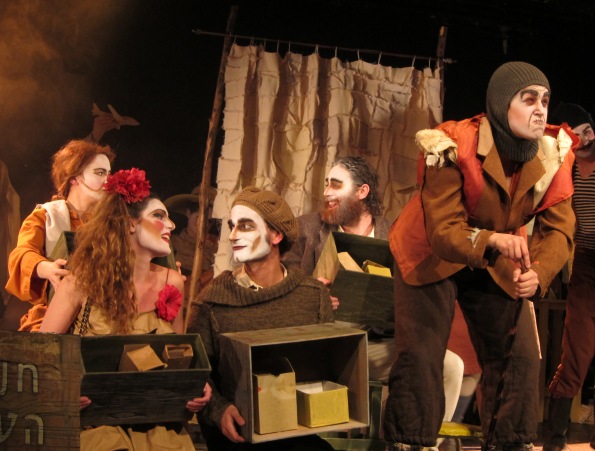
  • My idea is that the only characters with elaborate makeup will be the Gods (Or perhaps even everyone). Traditional, pale makeup with the really sharp eye makeup designs used traditionally in China. This will symbolise the fact that they are not human and contrast sharply against their casual clothing that we plan to use (suits or something formal). This will create an alienation effect (especially if we choose to give everybody white makeup. Still undecided)
  • Other simple makeup effects will be wrinkles, dirt, ect.

Tuesday, 8 January 2013

Practitioner: Stanislavski (history and personal opinion)


Stanislavski Presentation Notes

Born 5th January 1863 as Konstatin Sergeyevich Alekseyev in Moscow – father was a wealthy merchant, mother had an appeal for acting on stage
First experience of “What is good acting?” was when he was told to mime putting a stick into a fire. He actually put it into the fire and started a new one
At age 14 his father turned a wing of their country home into a theatre (This was his first time on the stage and he thought that he was great but the audience didn’t agree too much with him. They thought he went too fast)
His family started their own theatre group “The Alekseyev Circle”
He kept a journal of all his performances and was very self-critical
He discovered the importance of restraint and control “a feeling of true measure”
The audience always had criticisms about the speed, clarity and volume of their performances and after spending so much time trying to make these various things perfect, Stanislavski felt as though there was no life in the performance.
In their free time, The Alekseyev circle dressed up as beggars, drunkards or gyspies and acted as them in the train stations. They were told to leave numerous times so they must’ve been believable.
A Practical Man 1883 – The company decided to live their roles throughout the day (during meals, walking around, etc.)
His performance was perfect but a few women were saying how it was a shame he wasn’t good looking, so he became obsessed with his looks.
After his obsession he discovered that this vanity was leading him away from true art: “Love the art in yourself, not yourself in art.”
He started to study acting at a drama school in 1885 but left after 3 weeks because he thought that students were shown what they should aim for but not taught how to get there
After the break up of the Alekseyev Circle he started to participate in a few amateur acting companies. This made him concerned about his position in society (as an amateur actor by night) so he made the stage name “Stanislavski” and kept his acting life a secret
His parents turned up to one of his performances and afterwards his dad told him to “start a good company instead of taking part in filth”
He started The Society of Art and Literature (1888)
He had his own ideas on how to play different characters and how they would look but he got laughed at for his ideas
The director showed him how to play his role but he found it very different seeing something done and doing it yourself
For one of his roles, he spent a night locked in the cellar of a medieval castle to try and find the true feeling of his role. He ended up just getting a bad cold
In 1897 he started his first professional theatre company with Nemirovich-Danchenko: The Moscow Art Theatre (in which they wanted to rebel against the old manner of acting)
He died on August 7th, 1938 in Russia
Before the Alekseyev circle started, as a child, Stanislavski started own circus troupe “Konstanzo Alekseyev Circus” with his family and friends. He was the director and liked to take the best parts for himself. His oldest brother didn’t take it seriously.
For Stanislavsky (even at a young age) reality was the most important thing
He gave up his circus and started a puppet show where he loved creating realistic dramatic stage effects
He was very clumsy and used a mirror to practice his actions. A practice which he later condemned because it encouraged him to look at his outer self than inner self. He also tried imitating other actors but he realised this only created an external method
Stanislavski saw Tomasso Salvini playing Othello in 1882 which he thought was the model of truthful acting. He asked himself: What was the secret of great acting?
Mikhail Shchepkin (1788-1863 the year Stanislavski was born) said– “Take your models from life.” This quote really stuck a chord with Stanislavski and because of it he researched and read everything on Shchepkin and based a lot of his believes off of his.
Ernesto Rossi told him that all he needed in his plays was art and that had to come from himself. Not a teacher.
Stanislavski realized that he had to abandon the old and conventional tricks of the stage (something he calls “stencils”). He knew he had to live the role instead of just playing it and showing its emotions. He thought the hardest thing of all is standing on the stage and really take seriously everything that happens around him. He said “When you play a whiner, look for where he is happy. When you play a good man, look for when he is evil, and in an evil man where he is good.”
He also found that when he controlled himself and didn’t surrender completely to the role it was better. The more he tried to stay calm, the more the emotion was able to build up inside him. This allowed him to release all his emotion in the climatic scenes and is an Important technique for a sense of progression; by building by degrees to the climax of a role
He loved dramatic effects and was happy when he succeeded in finding a trick which deceived the audience.
In 1898 he stages Hauptemann’s The Sunken Bell and the set was mad up of hill, hollows and trees. He wanted the actors to not be able to walk on the set but to climb, sit, leap, balance, and crawl all over the stage.
Stanislavsky moved away from copying actors but to find his models in real life. He slowly learned to become an “actor of feeling”
In 1900 he played Doctor Stockman in Henrik Ibsen’s An Enemy of the People who understood immediately and he began to live him. He became Doctor Stockman, his transformation was complete. Other people who came in contact with him were convinced they were in the presence of another person. There had been a student demonstration the day of his performance and some of the students had come to see the show afterwards. At the end of the play, Doctor Stockman says “When you fight for freedom and truth, you shouldn’t put on a new pair of trousers.” And the audience went wild turning the play into another demonstration turning the production into a major political event. All Stanislavski was trying to do was creating the character and living the role.


Opinion: I think that, out of the few practitioners that I’ve studied so far, Stanislavski’s method makes the most sense and is the most straight forward. His history, particularly childhood, was so interesting for me to research about because of his constantly being exposed to theatre through his family. I mean who’s father builds a family theatre?! The idea of finding the logical actions of a character and the life within them is something that I’ve witnessed happen and not happen on stage, so I know what kind of difference these things can make in a performance.


Practitioner: Pina Bausch & Anne Bogart

Bogart

Bogart
American theatre director
SITI company
Developed “Viewpoints” technique
Written several works on theatre

Pina
German (born 1940)
Studied at Julliard
Joined Folkwang Ballet Company (became artistic director)
Died of lung cancer (2009)
By moving to new york she was able to pull away from traditional ballet
Feeling of nothing being concrete affected her as an artist
Her dances were against the status quo
Influences: Anthony Tudor (instructor at Julliard, emotional gestures), Martha Graham (metaphorical/abstract), Rudolf Laban (everyday movements, huge influency on a lot of atists), Kurt Jooss (one of Germany’s most influential choreographers)

Shared experiences with dancers rather than vocabulary movements (more focused on the process/journey to the end product) wanted dancers to express their own experiences. Mainly solos
Plays with reality whilst leaving room to dream and be imaginative (disturbing yet leaves us hopeful)
Expressing emotion physically. Emotions essential for dance to become. Reflects on the problem in life. Interaction between man and woman.
Architecture
Collaborations: Rolf Borzik (designed sets and costume used for dance theatre. Agreed that the styles at the time weren’t right. Major part of the dances are costume and set so without these people a lot of what became her dances wouldn’t be as it is), Marion Cito (Asked to take over for costumes after Bozrik’s death, extended Borzik’s approach), Bertolt Brecht & Kurt Weill
Techniques: Repetition (captures themes of the dances, ritualistic, Recontextualizing common gestures to heighten the meaning), Employment of different races and athnic groups (able to work with people from loads of countries, different experiences), Speech (non traditional, talking during a piece “wasn’t dance”), Uses more of the upper body (most of emotions and thinking happens in the upper part of the body),
Works: Café Muller (deserted café with scattered tables and chairs spread out that dancers stumble into and move the chairs around, etc.), Rite of spring (stage covered in soil, ritual of mating, girls are scared, ), Kontakthof (all actions are minimalistic, where the dancers showcase themselves infront of the audience, original one the actors were all 50 and up).
Tanztheatre Wuppertal (Wuppertal Ballet): near her birth town Solingen, Different performances, Works generate expression not teaches it, ensemble were very different

Minimalistic, simplistic ways of moving that captures thoughts and emotions that can’t be explained in any other way.

Practitioner: Bertolt Brecht


Studied medicine for most of his life
Was in the army but couldn’t fight because he had a face twitch

Religious
Most political play – The Rise and Fall of the City Mahagonny caused

Established Berliner Ensemble Company

Mother was a devut protestant and made a huge impact on his beliefs
Father encouraged him into medicine and the wars

Likes to look at the absurdity that people lived their lives
Lived in Germany during WWI and WWII
Look at worldwide events and observe it, not be involved in it
Marxism – “order created from chaos”. Order can only be found in disorder

First collaborated with Lion Feuchtwanger

Hans Eisler – Austrian composer
- music shouldn’t be

Kurt Weill – German composer

Only have props on set that are needed.

Philosophies – Know that they are actors playing characters
Wanted the audience to not feel emotional towards the characters. Look at the situation critically. “Alienation effect”

Everything was shown (backstage, stage crew)
Actors need to show that they are just actors
All this is to make the audience think critically about the events

Juxtaposition of emotion
Uses music to highlight the fact that it’s not a real scenario

Mother courage – doing what she must in order to survive

Brecht
Key figure of 20th century theatre.
Essence of naturalism (what lies behind most modern performances)
Born into conflict and contradictions
WWI when he was 16. Many of his friends died. Financial, political, personal instability
Escaped trench warfare by working in medical
Surrounded by death and wounded
Moved to Munich then Berlin
Incredibly charismatic
Wrote everything
Devoted followers
Accused of taking other people’s ideas as his own
1920s divorced and married an actor and wrote plays
Exile 1933-1948
1948- death: berlin
Most plays were writing before he was able to perform then. Most were unperformed
Theories changed throughout his life
Theatre should not just reflect the world, but change it
Epic theatre
Used all kinds of resources and inspiration