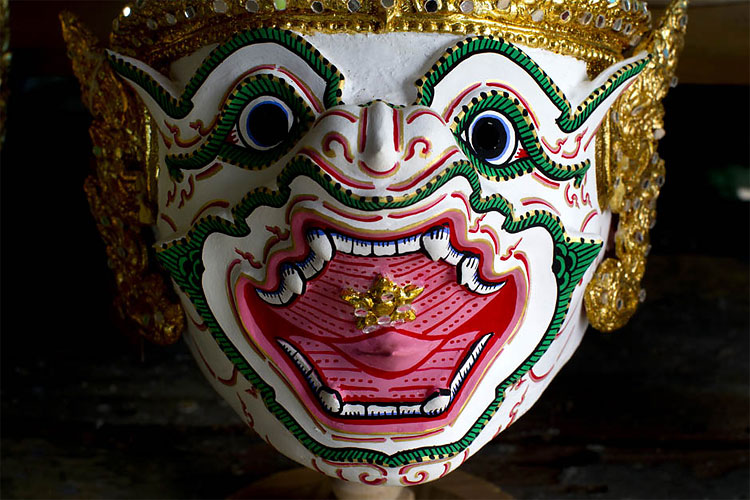
Sunday, 31 March 2013

Korean Talchum


  • Folk mask dance drama almost lost during japanese occupation
  • When watched, think about it as something that was fought for
  • Early 1960s historians, practitioners who have been able to find 15 to 20 different kinds of talcum. Different districts, different characteristics

Ideas
  • Spiritual base of respect for nature and respect for freedom of expression
  • Shamanism
  • Feelings of 한 (deep inner sentiment that is manifested as a profound grief or sadness)
  • 심영불이 - release of han (artistic ecstasy or exhilaration that occurs at final dramatic moment when tears turn to laughter, darkness to light.)  (Farmers dance -  Think of the dramatic music, place of Han to Sinmyeong) (juxtaposes catharsis)
  • Self-expression, Strongly interpretational (own feelings)
  • The Madang 마당 - area of performance (they would perform in yards, village), theatre of the round
  • More westernised stages - thrust
  • Audience participation - usually an hour (shorter version), full version goes on for hours, audience is very important, characters speak to the audience, interact with audience, call and response (wanted to represent what was going on in peoples' lives)
  • Communal, relationship between viewers and performance, can become a place of debate, instead of fantasy world it is a realistic, grounded world
  • Freedom of time and space
  • Satirical - excellent device for satire
  • Ceremony of the mask - Most places, masks are burned after use (except Andong since they use wood) masks are made out of all kinds of materials
  • Mask colours and distortions (winkles, small pox/illness (not a sign of goodness)). Everything on the mask had was a symbol of the character
  • Size of the mask affected the motion of the dances (smaller have gestures that are closer to the body, more everyday lifelike)
  • Mask as a character in story (jaw in order to speak and fit properly) - articulated jaw
  • Bride (andong talchum) - First three years of brides life was lives in inlaws house (left eye up, right eye down (turning a blind eye and focusing on what you need to know), closed mouth)
  • Grandma - one eye is tearing, mouth wide open, she can say whatever she wants, between eyes, worry
  • Barmaid - say no up to a point, no political say, needs to speak a little to make a living
  • White speckles - means older, more meed leprosy (abnormal), wrinkles (lines), 
  • Depraved monk - excessive wrinkles, sexual promiscuity (exaggerated nose), alcohol, made fun of by audience
  • Fur - depraved, abnormal, more animal than human
  • Gourd - busan


Thursday, 14 March 2013

Colour Blind Casting

After reading this article about colourblindness in casting I can't help but have mixed feelings.
It's true and certainly extremely unfair that some people aren't getting cast for roles because of their race and how they look, but on the other hand, if the character isn't cast in its genuine race .....

tbc

- White as neutral
- Balance between social fairness and artistic approach


http://jezebel.com/5980419/many-major-theaters-believe-in-color-blind-casting-except-when-it-comes-to-people-of-color?post=56927608

Tuesday, 12 March 2013

The Face and the Eyes

The most interesting thing for me was how the angle of the eyes effects the angle of your body and spinal column and how different expressions and emotions are interpreted and shown in in the eyes and in the spinal column and the body.
Another thing I found really cool and made me think was the idea that these actors work for years and train for years to alter their face to show different emotions and feelings that can be considered as basic human emotions. It's strange to think that we have to teach and condition our own bodies to do these faces that are at the core of human emotions.
It's interesting to learn about the kabuki theatre and the ways they use their eyes at different angles during their performances and how their body translates this also through wide stances and postures. Another is the ideas of manis and keras.

"Eyes infront, Heart behind"

"When placed on the face it should enable one to experience a state of neutrality prior to action, a state of receptiveness to everything around us, with no inner conflict...when the student has experienced the neutral starting point his body will be freed, like a blank page on which drama can be inscribed."

Tuesday, 5 March 2013

APAC Theatre/Mark Hill Response

This past week has been incredibly crazy but also incredibly fun.
We started off this week with an awesome CT time that was Les Mis themed and although being a huge fan of Les Mis, I kind of hate it when people try to spoof it (which is very selfish on my half but I can't help myself). However, I must admit that this assembly was really fun and smart and funny.


After CT we started our 3 hour long session with Mark.


We started the class by talking about using the face as a mask. He taught us to exaggerate emotions on our face and take them to the extremes. The product of these ended up looking ridiculous and funny but after some practice of opening up our faces, feeling comfortable around others and not laughing, the effect of using the face as a mask was very effective. I found myself being able to do all happiness, fear and crazy, but I found myself having a huge difficulty doing sadness. He mentioned that some people just don't wanna go there sometimes and I think that this was a major reason why I just couldn't do it (especially considering that mood I has been in that day).

After school finished and we started our afterschool session with the IB yr2 and the APAC kids
(still haven't finished writing this part, thought I would go on and finish the part about how much I learned and loved APAC before I went on explaining what I did)
_________________________________________________________________________________


APAC itself was an incredible experience and honestly, I'm sort of glad that I didn't get on the actual team and was able to help out behind the scenes. I still learnt a lot of the stuff that the others got to learn, went out and did all the activities, met tons of new amazing people and got to hang out with them. I also was responsible for a lot of the things that happened behind the scenes and I just enjoyed running all the errands and sorting and organising things so much. I think I might've discovered a new love for backstage production elements :D. There's a sort of satisfaction that comes with 1) knowing that you're making someone's life a lot easier (in my case Mrs Moon and Mrs Hamm's) and 2) seeing something being used in a performance or just in one of the workshops and knowing that you were responsible for that (even if nobody else acknowledged it). 
I also got to talk to Ms Kelly a bit about her life and her experiences with Khatakali theatre and her life as a teacher and as an IB examiner. She also got to know a bit about me and my experience with IB theatre right now. She seemed genuinely interested in the theatre department here at SFS.


Another thing that I was super proud of myself for was the moment on the saturday when the translators weren't here for the tech meeting so I had to step up with my little knowledge in korean to explain Mr Jung's tech ideas. It ended up not being as difficult as I expected it to be and I think I impressed Mr Hill and Ms Kelly with my knowledge of theatrical terms ;) (go IBTA woot woot!!).


The BIGGEST impact that this weekend has had on my, however, was finding out more about korean theatre and culture and art. I don't know why but even though I had done those outings with my family thousands of times throughout my life, going with a group of artists and theatre people and Mrs Moon (who knows so much about korean culture) made me appreciate that AMAZINGNESS that is korea art. Watching Miso I got so many inspirations as to what to do with potential future productions, possible our next IBTA performance and even considering a future in studying korea art and culture (something I have already talked about with my father 2 days after I saw Miso)


I have so much more to say about what I learned about theatre, about myself and just general life things over this weekend that it would take me about 7 hours to write about (which although I am willing, I don't think would be a good idea considering how much work I have yet to do).

I'm just incredibly thankful for this opportunity I had to be a part of APAC in such an impactful was and also so thankful to all the apac kids for including me in things even though I technically shouldn't have been.


Thank you Mrs Moon and Mrs Hamm :)
Emma xx

Sunday, 3 March 2013

Masks

Korean: Andong Mask
Venetian Masks


Thai Masks


Thursday, 21 February 2013

Pajama Game - History Lecture : Mr Kent

1950s - WWII
2 emotions - Darkest period, happiest period
Hope/Despair
America during WWII
 America was previously a country of isolation
          - Resilience
          - Belief that they can solve their own problems
America ends up fighting Germany
       - Germany declared this war

Their victory was a tainted moral victory for US  
           Compromised victory because they aligned with communist Russia.
                - The US fired bombed cities
                - The US lost their moral compass through use of nuclear bombs and propaganda

Despair - had a sense of hope for African Americans
- WWII raised that blacks were needed by the americans. They spilt their blood with white people
- They dealt with tyranny abroad and at home

Women were in charge of themselves to a new degree - Propaganda embraced the equality of women
1945 - country town between despair and hope
Months after war victory, a new fear of communism .
This fear of communism starts to erode their hope.
Hope for blacks and women stop followed by a sense that their hope was misguided.
- Cloud of fear of communism and fear of the nuclear war (fear was even bigger because of their lack of technology and communications unlike our world now)
Nuclear war was the big downer for the 1950s


Labour unions - protect the rights of the workers
- became politicised
- collective bargaining (communism)

Moguls of industry had political power and had a fear of communism which was logical.
Russians declared "their objective for the whole world to be communist"
- US were agitated by work unions

Industries at that time had gone from producing domestic products to war machines back to domestic products.
Women's rights in the 1950s were the women saying "You owe us" to the men for taking over their role during the war.
- became angry that they had been expected to go back to their previous role
- their access to money had changed
- women decided how to spend money
- issues of domestic violence was highest in the 50s
- voters - politicians started listening to women

Despair
1. Men won't change - the patriarcal idea of men's control was under threat
2. some women gave in, some fought, some fled (divorce)

They actually fought the war to preserves what it meant to be american (this social unfairness comes with this)
Communism - men and women were equal

Despair that so little is changing and the change is taking so long.

Blacks weren't treated equally after fighting with whites

1945- everything seemed happy but deep down there was despair


Mother Courage movie


-       Kevin Kline (actor)
-       Jeep was a great way to bring it into a contemporary time period
-       “Man equals Man”
-       He changed the way German sounded
-       Once he became famous and “made it” he spent years studying Marxism
-       Research is in everyday new papers
-       “She’s looking for the war”
-       War’s good business “If it’s business, it makes sense.”
-       Fear was existent in the city, helicopter, actors were exhausted,
-       Everyone was constantly spoken about war
-       Fear of the atomic bomb
-       The only way to protect her family I to make her business thrive.
-       Her bargaining killed her son but by paying all that money to save her life would’ve condemned her whole family to death
-       Was afraid that his plays would never been seen by a German audience
-       McCarthy Trials – pretended to be bad at English so that he wouldn’t be asked as many questions
-       Enormous attention to detail
- Brecht had the emotional moments but has other elements to draw the audience away from the audience
- Brecht always have a tragic hero who is always killed by their virtue.
- He doesn't blame the characters.
- it's not the characters' faults. It's the society that they are in
- We're all gonna die unless we come up with a solution together
- Has the image that we see everyone "image of mothers over the bodies of their children saying why"
- She knew that she would lose her children
- Duality that occur in his plays (in everything: theme, character, plot, etc.)